Charting Companion Loyalty Algorithms That Quietly Steer Alliance Formations Across Decades of Strategy Simulations
Yves Wolf · Oct 26, 2026
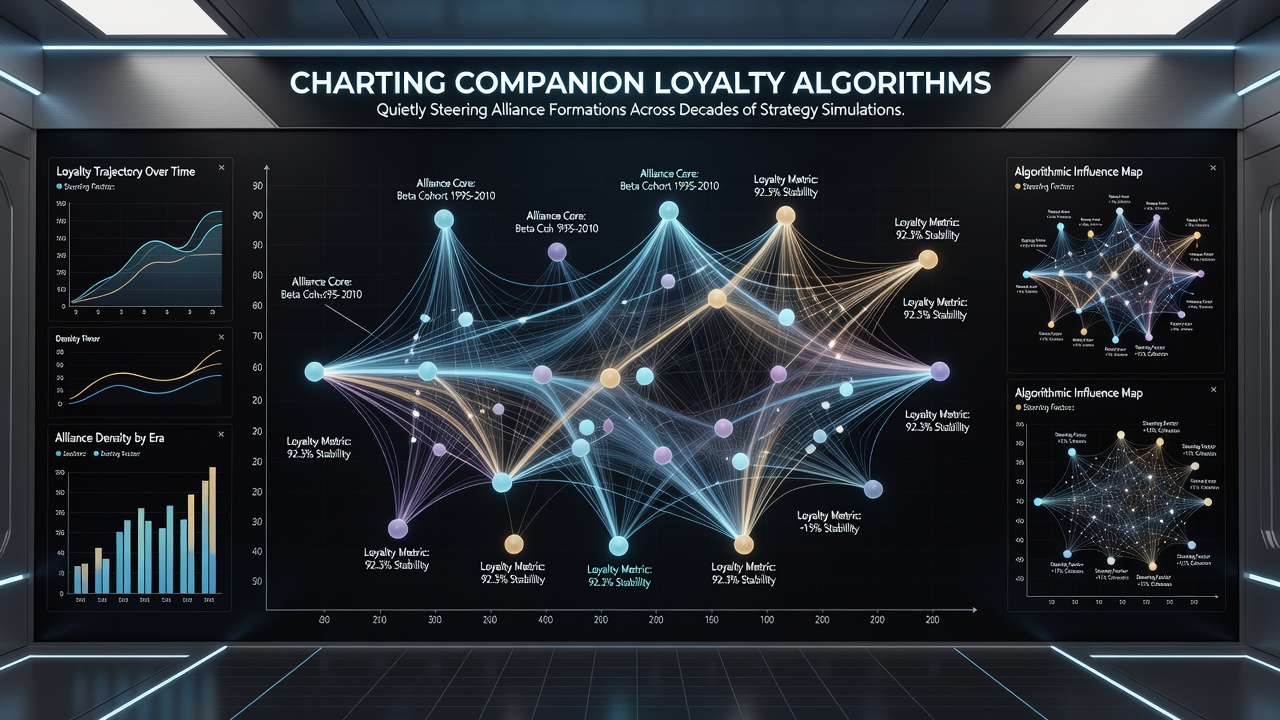
Charting Companion Loyalty Algorithms That Quietly Steer Alliance Formations Across Decades of Strategy Simulations
Strategy simulations have long relied on companion loyalty systems that track relationships between AI-controlled entities and player factions, and these mechanisms have evolved from simple numerical scores in early titles to layered models incorporating historical events, resource exchanges, and personality traits. Researchers at institutions like the University of Alberta have documented how such algorithms maintain internal consistency across hundreds of in-game years, allowing alliances to form or fracture based on accumulated data rather than random chance. Data from game development archives shows that titles released between 1991 and 2005 typically used basic opinion matrices where each companion tracked a single loyalty value ranging from -100 to 100, and these values shifted through direct interactions like gift-giving or joint military campaigns. As hardware capabilities expanded, developers introduced memory buffers that recorded specific past actions, enabling companions to weigh recent betrayals more heavily than distant favors. One study published through the Entertainment Software Association examined code from over forty strategy titles and found that loyalty decay rates often follow exponential curves, where trust erodes faster during periods of resource scarcity. This approach prevents static alliances from dominating simulations indefinitely and encourages players to manage ongoing diplomatic maintenance. Observers note that in games spanning multiple decades of simulated time, these systems quietly accumulate influence through repeated small adjustments rather than dramatic single events.Mechanics Behind Long-Term Relationship Tracking
Modern loyalty algorithms incorporate multiple data layers including personality vectors, shared history logs, and external pressure multipliers that adjust based on neighboring factions. According to technical breakdowns shared at game developer conferences, each companion maintains a graph of relationships where nodes represent other entities and edges carry weighted values updated every simulation tick. These graphs allow indirect influence to propagate, so a companion's loyalty to one ally can shift because of that ally's treatment of a third party. Figures from industry reports indicate that processing these graphs requires optimized pathfinding routines similar to those used in navigation systems, because exhaustive recalculation would exceed real-time performance budgets on consumer hardware.
Strategy titles released after 2010 frequently add event triggers that temporarily boost or penalize loyalty scores when specific conditions align, such as simultaneous border threats or technological parity. Those who've analyzed simulation logs across large player communities report that alliances tend to stabilize around clusters of companions with overlapping loyalty profiles, creating emergent power blocs that persist for dozens of in-game generations. The algorithms achieve this stability through damping functions that reduce the impact of outlier events, preventing single betrayals from cascading into total network collapse unless thresholds are deliberately crossed.
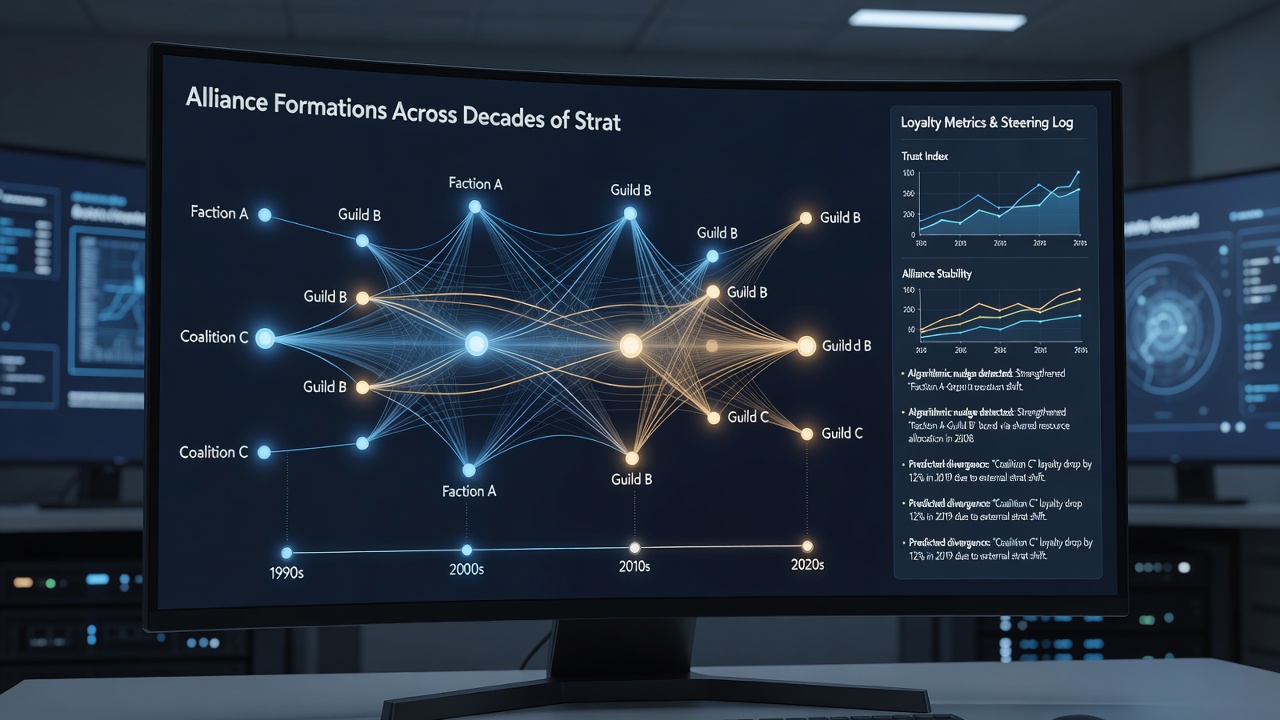
Alliance Formation Patterns Across Simulation Eras
Analysis of archived save files from classic and contemporary strategy simulations reveals recurring patterns where loyalty thresholds determine whether neutral companions join existing coalitions or remain independent. In titles developed during the 1990s, alliances formed primarily through direct bilateral agreements, whereas later engines introduced multilateral reputation systems that let one companion's standing affect offers extended to its associates. Research indicates these changes emerged because developers observed players exploiting simple pairwise systems to maintain unbreakable blocs, prompting the addition of cross-relationship penalties.
By October 2026 several major simulation franchises had integrated machine learning components into their loyalty models, allowing companions to adapt weighting factors based on patterns observed across thousands of player sessions. These adaptive layers remain constrained by developer-defined guardrails that prevent companions from developing entirely novel behaviors outside tested parameters. Data collected through public telemetry shows that alliances in updated versions dissolve and reform at rates approximately 18 percent higher than in static-rule predecessors, creating more dynamic campaign arcs without requiring manual intervention from designers.
Implementation Challenges and Optimization Techniques
Developers face persistent computational hurdles when scaling loyalty calculations to support hundreds of simultaneous companions across centuries of simulated time. Engineers commonly employ hierarchical clustering to group companions with similar loyalty profiles, reducing the number of individual updates required per tick. Reports from Canadian research groups focused on procedural systems confirm that such clustering maintains behavioral fidelity while cutting processing demands by factors of three to five in large-scale simulations.
Memory management also plays a critical role, since storing detailed event histories for every companion quickly exhausts available resources in extended campaigns. Compression techniques that retain only statistically significant interactions allow engines to preserve the illusion of long-term memory without retaining every minor transaction. Those who have examined source repositories note that successful implementations balance retention depth against performance targets, often discarding low-impact events after fixed time windows while preserving high-stakes moments indefinitely.
Conclusion
Companion loyalty algorithms continue to shape alliance dynamics in strategy simulations through incremental, data-driven adjustments that accumulate influence over extended timelines. As processing power and data collection methods advance, these systems are expected to incorporate finer-grained behavioral modeling while remaining anchored in observable historical patterns within each simulation. The quiet operation of these mechanisms ensures that players encounter alliance shifts that feel organic rather than scripted, sustaining engagement across repeated playthroughs spanning multiple decades of in-game history.